Wild Horses of Mongolia: Where They Live and How to See Them
The takhi is the last wild horse on Earth, and most of the world's herds live in Mongolia. Here is where they roam and how to stand in front of one.
 Written with Bat-Erdene Ganbaatar, Hustai National Park tour guide and wildlife specialist
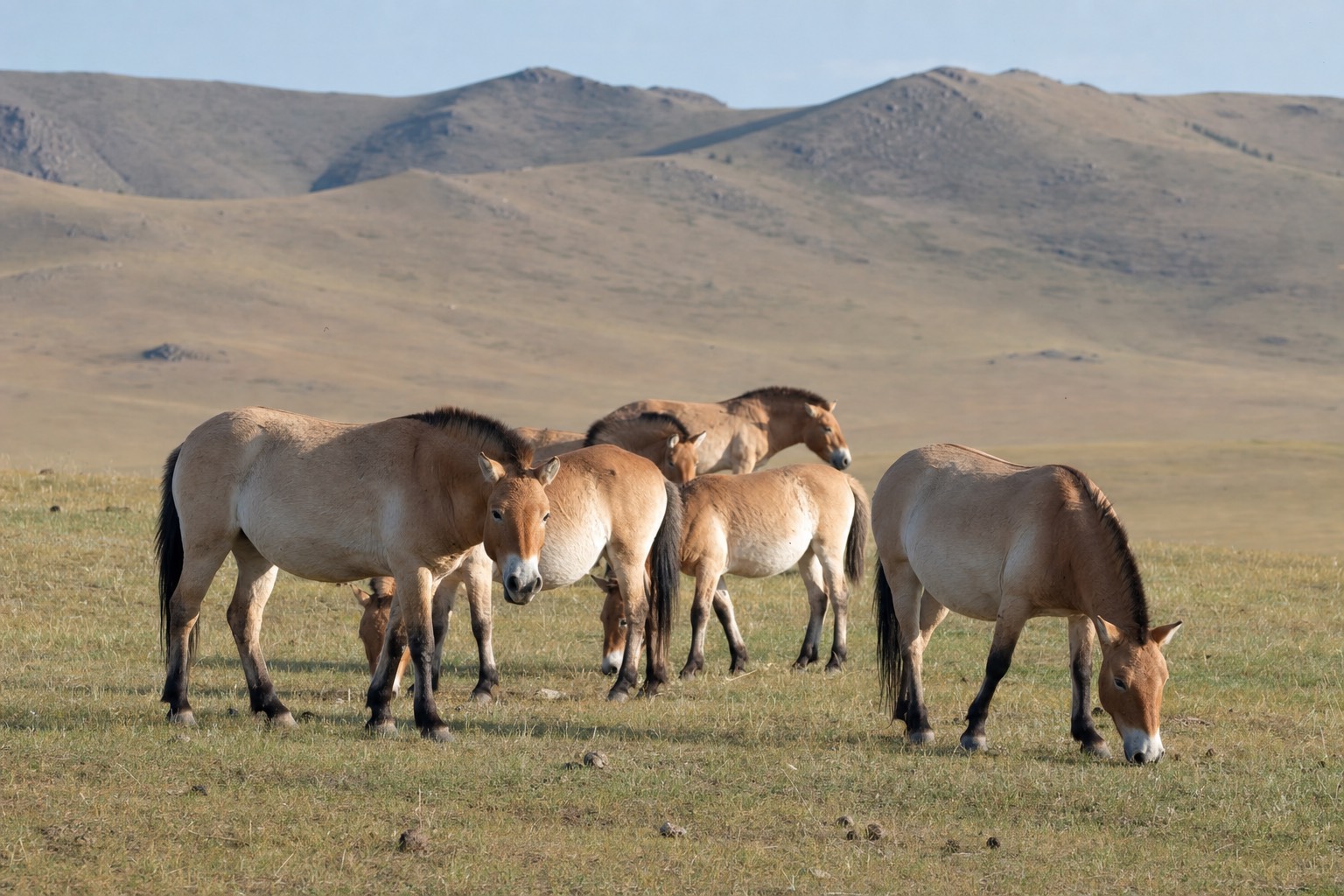
Are there wild horses in Mongolia?
Yes, Mongolia has genuinely wild horses called takhi (Przewalski's horse), the only horse never domesticated. The largest free-ranging herds live in Hustai National Park near Ulaanbaatar and the Great Gobi B reserve. Hustai, about 100 km west of the capital, is the easiest place to see them on a day visit.
Booking Choice: Turn the field guide into a full Hustai wildlife day with private transport from Ulaanbaatar, park admission and lunch included. Bring your own binoculars, camera equipment and suitable layers. See the private Hustai day experience
The first harem I ever showed to visitors was standing on a ridge at Hustai, backlit, tails flicking against the flies. One of my guests whispered, "Those are actually wild?" That question comes up on almost every drive I lead, and the answer surprises people. Mongolia holds the last population of horses that never passed through human hands. Not escaped ranch horses gone loose. Wild in the full sense, and you can watch them from a hillside less than two hours from the capital.
Yes, Mongolia has genuinely wild horses called takhi (Przewalski's horse), the only horse never domesticated. Discover Hustai's reintroduced population on a private wildlife day with transport, admission and lunch arranged. Explore the private Hustai wildlife visit
Are there wild horses in Mongolia?
Yes. Mongolia is home to the takhi, or Przewalski's horse, the only horse species on Earth that was never domesticated. Once extinct in the wild, it was brought back through reintroduction from the 1990s onward. The largest free-ranging herds now live at Hustai National Park and the Great Gobi B reserve, both inside Mongolia.
People often assume the horses grazing across the Mongolian countryside are the wild ones. They are not. Those are domestic horses, herded by nomadic families, tame enough to ride and milk. The truly wild horse is a separate animal with a separate story. The takhi disappeared from the wild by 1969, survived only in a handful of zoos, and was returned to the steppe starting in 1992 when the first horses arrived at Hustai from European breeding programmes.
A domestic horse and a takhi are not the same species in the loose sense either. The takhi carries 66 chromosomes against the domestic horse's 64, wears a sandy dun coat with a dark upright mane and a dorsal stripe down its back, and cannot be tamed or ridden. It is also the national animal of Mongolia, a point of real pride here. For the fuller species story, our complete guide to the takhi walks through the biology and the comeback in detail.
Where is the best place to see the wild horses?
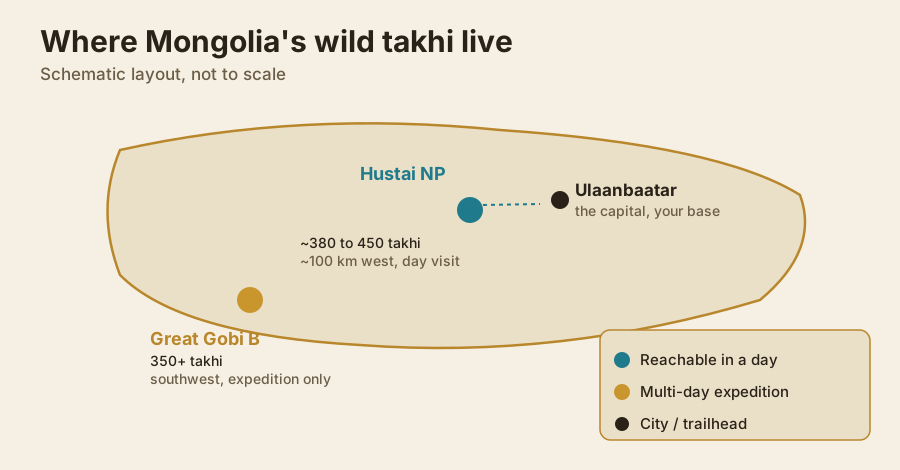
The best place is Hustai National Park, about 100 km west of Ulaanbaatar. It holds one of the world's largest free-ranging takhi populations, roughly 380 to 450 horses, and sits within a 1.5 to 2 hour drive of the capital. The Great Gobi B reserve in southwestern Mongolia holds another large herd but is far harder to reach.
Hustai works for one simple reason: access. The park lies on a paved road with a short gravel approach, guides accompany every wildlife drive in the protected zone, and the harems reliably come down into the valleys at dawn and dusk to graze and drink. For a traveller based in Ulaanbaatar, it is the only site where seeing a wild horse fits inside a single day.
The Great Gobi B Strictly Protected Area, out in the Dzungarian Gobi near the Chinese border, holds over 350 takhi and is the other genuinely wild Mongolian population. It is a serious expedition, days of driving from the capital, and not something you fold into a short trip. The table below compares the realistic options.
| Site | Region | Takhi population | Access from Ulaanbaatar | Day visit? |
|---|---|---|---|---|
| Hustai National Park | Töv Province, ~100 km west | ~380 to 450 | 1.5 to 2 h drive, paved road | Yes |
| Great Gobi B | Dzungarian Gobi, southwest | 350+ | Multi-day expedition | No |
| Zoos and reserves abroad | China, Russia, Europe | Varies | Not in Mongolia | No |
If your window is short and you are starting from the city, Hustai is the answer. Our guide to the best time of year to visit Hustai breaks down which months give you the strongest odds of a clean sighting.
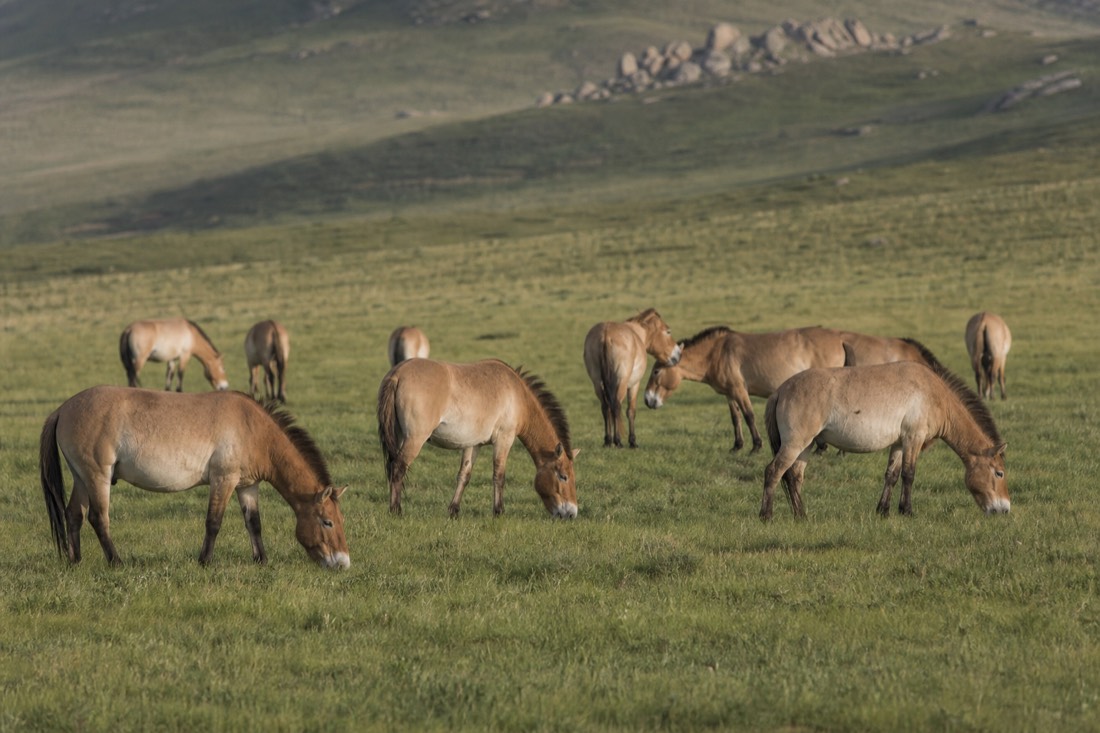
What other wildlife shares the steppe with the horses?
Hustai is not a single-species park. Alongside the takhi it protects 55 mammal species and 223 bird species. Visitors most often see tarbagan marmots and red deer, whose herd has grown from around 50 animals to over 1,300. Wolves, Mongolian gazelle, Siberian roe deer, and birds of prey also live here, though these are seen less often.
I tell guests to arrive wanting the horses but open to the rest. On a slow horse morning the marmots save the day, standing sentry at their burrows and whistling as the vehicle passes. The red deer recovery is one of the park's quieter triumphs, a roughly 26-fold increase over about 25 years of protection. Wolves are present and shape the whole system, but I have seen them only a handful of times in years of guiding. Manage the expectation and the steppe rarely disappoints. Our honest rundown of what animals you can realistically expect at Hustai sets the odds straight.
Wild, feral, or domestic: what makes the takhi different?
A wild animal descends from populations never domesticated. A feral animal is a domestic one gone loose, like America's mustangs. A domestic animal is bred and kept by people. The takhi is the only living horse in the first category, which is why biologists call it the last true wild horse.
The distinction matters because it is constantly muddled. Mustangs are magnificent, but they trace back to Spanish domestic horses that escaped or were released, so they are feral. Brumbies in Australia are the same story. The takhi never went through that cycle. It also failed every historic attempt to break it to saddle, which is part of why the domestication never took.
| Category | Definition | Example | Can be ridden? |
|---|---|---|---|
| Wild | Never domesticated, ancestral lineage | Takhi (Przewalski's horse) | No |
| Feral | Domestic stock gone loose | Mustang, brumby | Yes, if re-tamed |
| Domestic | Bred and kept by humans | Mongolian riding horse | Yes |
There is a genuine scientific debate about the takhi's ancestry that we treat carefully in our piece on whether the takhi is truly wild. The short version stands: it was never domesticated, and no other living horse can claim that.
How do you actually watch them without disturbing the harem?
Keep 200 to 300 metres between you and any harem, stay on the tracks, never feed the animals, and let the park guide position the vehicle. Sightings peak at dawn and dusk when the horses move down to the valleys. Bring binoculars or a long lens, because the safe viewing distance is real and enforced.
My own method on a drive is to place guests uphill and downwind of a harem, engine off, and let the horses set the pace. Approach on foot toward a wild horse and it simply leaves, so patience beats pursuit every time. A stallion guards his mares and foals closely, and a spooked harem can vanish over a ridge in seconds, costing everyone the sighting.
Here is the fast-fact sheet I run through with new visitors before we head into the protected zone.
| Fact | Detail |
|---|---|
| Species | Takhi, Przewalski's horse |
| Chromosomes | 66 (domestic horse has 64) |
| Coat | Dun, dark erect mane, dorsal stripe |
| Status | Endangered (IUCN, since 2011) |
| Safe distance | 200 to 300 m from any harem |
| Best viewing | Dawn and dusk, spring and autumn |
| National animal | Yes, of Mongolia |
For the numbers behind the recovery, see our breakdown of how many Przewalski's horses are left today. The trend line is one of conservation's better news stories.
If you want to see the horses on the ground, a practical route is a guided trip out of Ulaanbaatar, but golden-hour timing must be confirmed and is not guaranteed.
The official park body, the Hustai National Park Trust, publishes current conservation figures on its official park site, and the species background is well documented on the Przewalski's horse entry at Wikipedia. Both are worth a read before you travel.
Beyond Hustai, how do the world's other takhi sites compare?
Hustai holds the largest single population, but four other places on Earth carry free-ranging or semi-wild takhi: the Great Gobi B reserve, several reintroduction sites in China, the Orenburg steppes in Russia, and the Chernobyl exclusion zone in Ukraine. None combine wild takhi and easy access the way Hustai does.
Every one of these sites traces back to the same tiny founder group, so in a real sense they are branches of one recovery project rather than separate rediscoveries. China now holds the largest national share of any country, more than 900 horses spread across reserves built up over decades of dedicated breeding work. Russia's programme is smaller and newer, concentrated on the Orenburg steppes near the Kazakh border. Ukraine's Chernobyl population began almost by accident: horses released into the radiation exclusion zone in 1998 found an empty landscape with no farming, no hunting, and no people, and simply stayed. No current official headcount for that herd turned up in our research, which is itself telling. It exists largely outside the formal conservation bookkeeping that tracks Hustai and the Gobi.
| Site | Country | Population (latest estimate) | Free-ranging since | Reachable on a short Mongolia trip? |
|---|---|---|---|---|
| Hustai National Park | Mongolia | 380 to 450 | 1992 | Yes, day trip from Ulaanbaatar |
| Great Gobi B | Mongolia | 350+ | Multi-decade reintroduction | No, multi-day expedition |
| China (multiple reserves) | China | 900+ | Long-running reintroduction programme | No |
| Orenburg steppes | Russia | ~125 (of 133 nationally) | Newer reintroduction | No |
| Chernobyl exclusion zone | Ukraine | Free-roaming, no current official count found | Since 1998 | No |
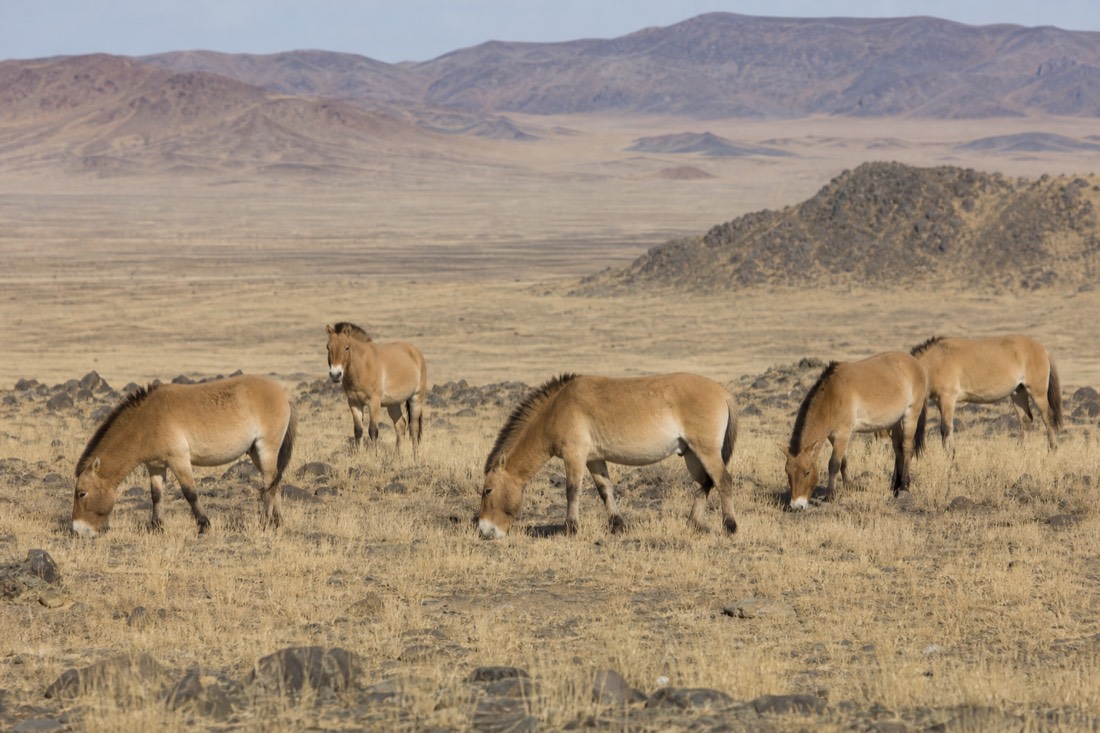
For a traveller with one trip to Mongolia and a fixed number of days, this table settles the practical question by itself. Hustai is the only site on it where a wild takhi sighting and a same-day return to a hotel bed both fit.
How does the takhi actually stack up against a mustang or a brumby?
Trait for trait, the takhi is stockier, carries two more chromosomes, has never been ridden, and lives only in Mongolia's reintroduction sites, while mustangs and brumbies are leaner, share the domestic horse's 64 chromosomes, can be retrained to saddle, and roam the American West and the Australian outback.
The wild-versus-feral distinction covered earlier in this guide is the headline difference, but the animals also look and move differently once you know what to check. A mustang band on a Nevada plain will often let a vehicle approach closer than a takhi harem ever would, because generations of handling sit somewhere in a mustang's ancestry even after years running free. A takhi has no such history to draw on. Body shape gives it away too: a mustang tends toward a leaner, longer-legged build closer to its Spanish and ranch-horse ancestors, while a takhi keeps the compact, heavy-headed profile of an animal built for steppe winters rather than speed.
| Trait | Takhi | Mustang | Brumby |
|---|---|---|---|
| Domestication history | Never domesticated | Escaped domestic Spanish stock | Escaped colonial domestic stock |
| Chromosomes | 66 | 64 | 64 |
| Range | Hustai and Great Gobi B, Mongolia | Western United States | Australian outback |
| Mane | Short, erect, no forelock | Long, falls to one side | Long, falls to one side |
| Can be ridden | No, never successfully tamed | Yes, if retrained | Yes, if retrained |
| IUCN status | Endangered | Not classed as a wild species | Not classed as a wild species |
Guests who have seen mustangs in the American West sometimes expect something similar at Hustai and are surprised by how different the takhi looks and moves. That reaction is one more piece of evidence for the point made earlier in this guide: this is not a loose domestic horse, it is a different animal wearing a horse's shape.
What is it actually like to watch a wild harem? Bat-Erdene's view
In more than four years of guiding at Hustai, I have learned that watching a harem rewards patience over enthusiasm. The horses do not perform. They graze, they watch you back, and the best sightings come from sitting still longer than most visitors expect to.
I have guided over a thousand travellers into this park since 2022, and the pattern repeats itself often enough that I can predict it. A group arrives keyed up, cameras ready, expecting the horses to do something dramatic. Mostly, the horses do not cooperate with that expectation. A harem grazing at 300 metres will lift its heads when the vehicle stops, assess for a minute or two, and then go back to eating grass if nothing changes. That pause, that moment of mutual assessment, is the part I actually want people to notice. It is the clearest proof you will get that these are not tame animals performing for an audience.
Not every visit lands a clean sighting, and I say that upfront rather than let people find out the hard way. One honest account I have seen online, from a traveller expecting the ten-plus species some guidebooks promise, described coming away having mainly seen marmots, ground squirrels, and the takhi themselves. That is a realistic outcome, not a failure. The horses move with the light and the season, and a guide's job is reading where they will be, not guaranteeing where they are.
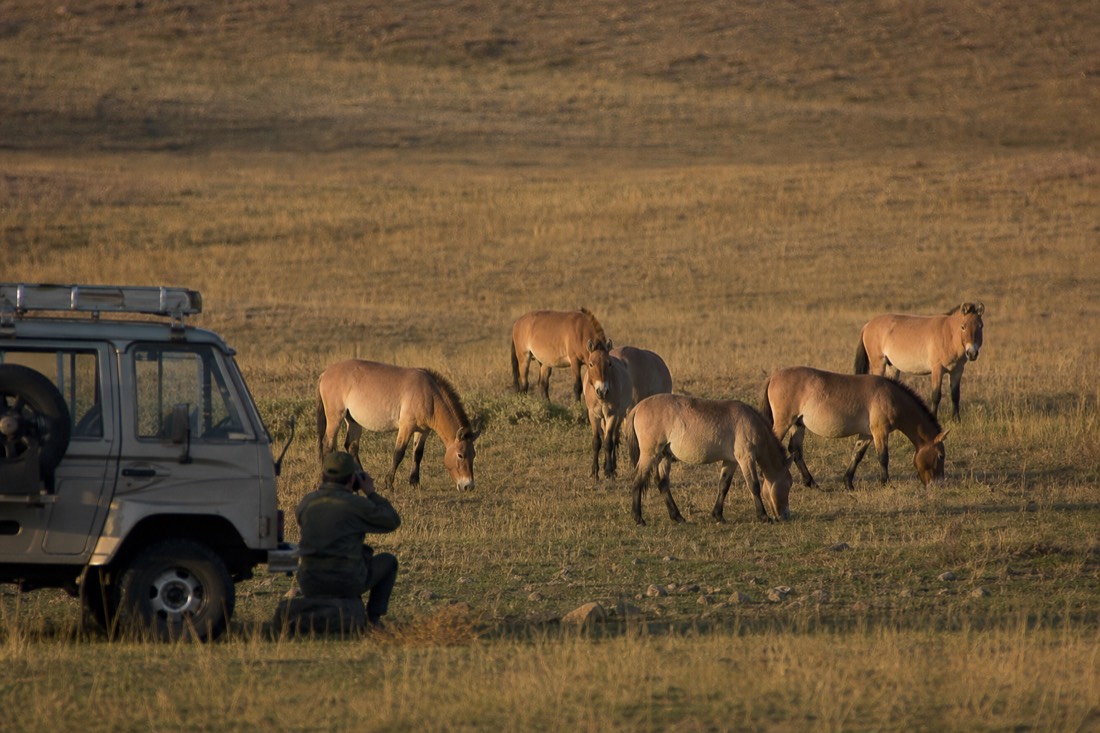
What turns a mediocre sighting into a memorable one is almost always the light and the wait, not the number of horses. A single harem grazing calmly for twenty unhurried minutes at golden hour beats a distant, brief glimpse of three harems at midday, every time.
What does a realistic dawn-to-dusk viewing window actually look like?
Takhi behaviour follows the sun more than the clock: they graze the valley floors in the first two hours after sunrise, retreat to higher, shaded ground through the heat of the day, and come back down in the two hours before sunset. Planning around those windows, not around a fixed schedule, is what actually produces a sighting.
This is a behaviour pattern, not a timetable any tour can promise, but it is consistent enough to plan a visit around. Arrive at the park before the morning window closes and you are working with the horses' habits instead of against them. Arrive at noon expecting the same odds and you have chosen the hardest hour of the day to find them.
| Approximate time | What the horses are typically doing |
|---|---|
| First light to two hours after sunrise | Grazing the valley floors, most visible and active |
| Mid-morning to mid-afternoon | Moving to higher, shaded ground, harder to spot |
| Two hours before sunset to dusk | Returning to the valleys to graze and drink |
| After dark | Settled for the night, drives end |
None of this is exact, and a harem on a cool, overcast day may stay lower longer than one baking under a clear summer sky. What holds steady across seasons is the shape of the pattern: down at the edges of the day, up and hidden through the middle of it. Building a visit around dawn or dusk, as this guide has said from the start, is not a marketing line. It is simply where the animals are.
What do you actually need for a serious wild-horse viewing session?
Bring binoculars or a long lens, cash for the entrance and vehicle fees, layered warm clothing even in summer, and clothing in muted colours. The 200 to 300 metre distance rule means you will rarely be close, so the right gear does more for your sighting than luck.
None of this is complicated, but visitors forget at least one item on almost every drive I run. The distance rule is the whole reason the packing list looks the way it does: at 250 metres, the naked eye gives you a horse-shaped smudge on a hillside, while a pair of binoculars or a 200mm-plus lens turns that smudge into a stallion watching you back. Cash matters because the entrance fee and the separate vehicle fee are paid at park headquarters on arrival, and card machines are not something to rely on out here. Layered clothing matters because dawn and dusk temperatures on the steppe drop hard even when the afternoon feels mild, and Hustai stays open through Mongolia's genuinely severe winters for those who visit that season.
| Item | Why it matters for watching takhi |
|---|---|
| Binoculars or a 200mm+ camera lens | The enforced 200 to 300 m distance keeps every sighting far away |
| Cash (USD or MNT) | Entrance and vehicle fees are paid at park headquarters on arrival |
| Layered warm clothing, even in summer | Dawn and dusk are cold on the steppe regardless of the midday temperature |
| Muted, neutral-coloured clothing | Bright colours and sudden movement are more likely to make a distant harem move off |
| Flexible timing, not a fixed schedule | The horses set the pace around dawn and dusk, not the clock |
The colour point surprises people most. It is not that a takhi can pick out a red jacket from 300 metres and panic, it is that any sudden contrast against the steppe's muted browns and greens draws the eye of an animal that has survived by staying alert to exactly that kind of change. Dress to blend in and you improve your odds of a longer, calmer sighting rather than a brief one before the harem drifts over a ridge.
Common questions about Mongolia's wild horses
Are the takhi dangerous to visitors? They are wild animals and will defend their harem, but at the enforced 200 to 300 m distance they pose no risk. Problems only arise when people approach on foot, which is prohibited.
Can I ride a wild takhi? No. The takhi has never been successfully tamed or ridden, and it is a protected species. The riding horses you see across Mongolia are domestic animals, an entirely separate lineage.
Is Hustai the only place in Mongolia to see them? No, but it is by far the most accessible. The Great Gobi B reserve holds another wild population, though reaching it takes a multi-day expedition rather than a day visit.
What time of year is best? Spring (April to May) and autumn (September to October) give the strongest sightings, with mild weather and active harems. The park stays open year-round, but winters are severely cold.
Choose Your Next Step
Private Hustai Wildlife Day
Have your travel date in mind? Check Private Hustai Wildlife Day before arranging the rest of your trip.
8 to 10 hours. Private transport, lunch and park admission; pickup offered from Ulaanbaatar. English, French, Korean or Russian. Wildlife and a dawn departure are not guaranteed. Not wheelchair accessible; not recommended during pregnancy.
Compare Trip Styles And Adjust Your Choice
- Six-Hour Hustai Day: About 6 hours. Downtown Ulaanbaatar hotel transfers, local lunch, entrance and an English- or Mongolian-speaking guide. Not suitable for mobility impairments. Sightings are not guaranteed. Arrange your own travel insurance.
- Two-Day Hustai And Nomadic Homestay: Two days with a private ger at a nomadic family, meals and Ulaanbaatar hotel pickup. English guiding. This is not either named Hustai tourist camp. Riding and the cultural show cost extra. Not wheelchair accessible.
This is trip guidance, not an eligibility or availability confirmation. Check the operator's restrictions for everyone travelling.
Choose a date to inspect the Viator departure schedule. Final availability and price are confirmed on Viator.