The Chernobyl Horses, and Why Hustai Is Where You Actually Go
Przewalski's horses roam the Chernobyl exclusion zone after a 1998 release, and the story fascinates people. How that accidental refuge differs from Hustai's managed reintroduction, and why Mongolia is where you can actually see the wild takhi.
 By Bat-Erdene Ganbaatar, Hustai National Park tour guide and wildlife specialist
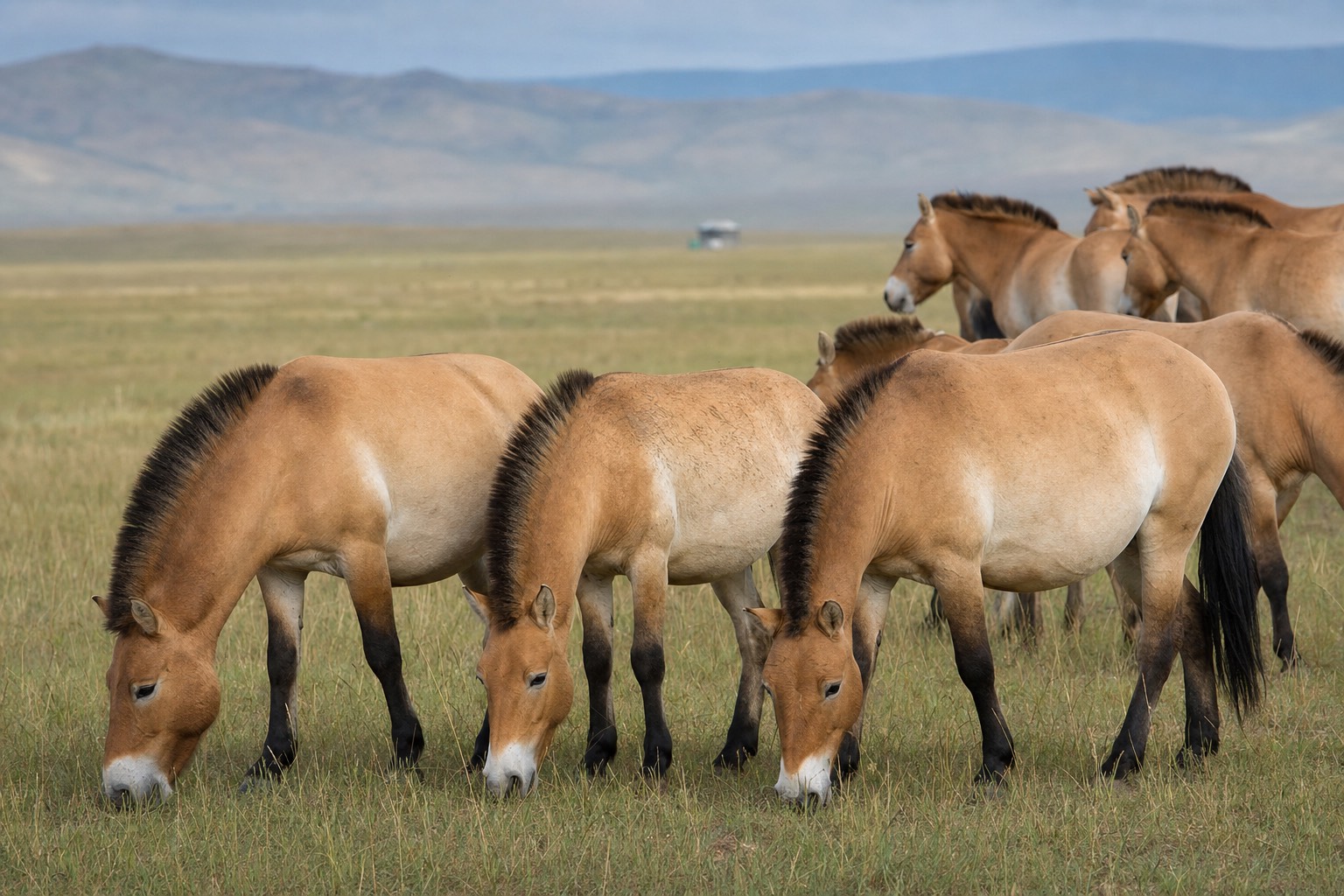
TL;DR: Przewalski's horses were released into the Chernobyl exclusion zone in 1998, and a free-roaming herd has bred there ever since, one of the stranger conservation footnotes going. But the zone is not somewhere you visit to watch wildlife. Hustai in Mongolia is the real reintroduction success and the place you can actually go, about 100 kilometres from Ulaanbaatar, to see the wild takhi.
Discover Hustai's living reintroduction story on a private wildlife visit that arranges transport from Ulaanbaatar, admission and lunch, leaving you free to focus on the reserve. Explore the private Hustai wildlife visit
Booking Choice: Check your travel date for the private 8 to 10-hour Hustai visit before arranging your other Ulaanbaatar logistics. Check private Hustai availability
People bring up the Chernobyl horses more than you would think. Someone in the group read that wild horses roam the world's most famous nuclear exclusion zone, and it lodges in the mind, animals thriving where humans cannot live. It is a genuinely fascinating story. It is also a completely different kind of story from the one you are standing in when you come to Hustai, and pulling the two apart is worth doing before you plan anything.
I guide the Mongolian side of this. What I can tell you clearly is which of these two places actually lets you watch the horses, and which one is a headline you read from a safe distance.
Are there really wild horses at Chernobyl?
Yes. In 1998, a group of Przewalski's horses was released into the Chernobyl exclusion zone in Ukraine as an experiment in restoring large grazers to abandoned land. With people gone, the herd bred and spread through the zone over the following decades, becoming one of the few free-roaming populations of the species outside its Mongolian range.
The logic behind the release was straightforward. The exclusion zone had become a vast, accidentally rewilded landscape: villages emptied, farming stopped, and grassland reclaiming the fields. Introducing a hardy wild grazer that once ranged across the Eurasian steppe was a way to study how the ecosystem and the horses would respond with almost no human interference.
What makes it striking is the absence of us. There is no management in the Hustai sense, no daily monitoring drives, no visitor programme. The horses simply live there, in the odd sanctuary that human catastrophe left behind. For the wider background on the species itself, the Przewalski's horse guide covers what these animals are and why they matter, and the Smithsonian's overview is a solid primary reference.
| Zone fact | Detail |
|---|---|
| Where | Chernobyl exclusion zone, Ukraine |
| Released | 1998 |
| Why | Restore a wild grazer to abandoned, rewilded land |
| Management | Minimal; the herd is largely left to itself |
| Human presence | Restricted; not a wildlife-viewing destination |
How is Chernobyl different from Hustai's reintroduction?
They could hardly be more different in intent. Chernobyl was opportunistic rewilding into land humans had fled. Hustai is a deliberate, decades-long conservation programme: takhi were flown back from European zoos starting in 1992, released in managed stages, monitored ever since, and protected inside a UNESCO biosphere reserve. One is an accident of history. The other is a planned homecoming.
At Hustai, everything is intentional. The official park site documents a programme that chose founder animals for genetic health, gave them enclosures to adapt, and built a trust to guard the ground and count the herds year after year. Rangers accompany wildlife drives, distances are enforced, and the whole reserve exists to keep the species going. At Chernobyl, the "programme" was largely to open the gate and step back.
Both landscapes work for the horse for the same underlying reason, which is space empty of people and full of grass. But only one of them is set up for you to witness it. The comparison table below lays it out, and if you are weighing Hustai against other things to do near the capital, the Hustai versus Terelj guide handles that side.
| Feature | Chernobyl zone | Hustai National Park |
|---|---|---|
| How horses arrived | Released 1998 into abandoned land | Flown from zoos from 1992, managed reintroduction |
| Intent | Opportunistic rewilding | Deliberate species recovery |
| Ongoing management | Minimal | Active monitoring, ranger-led, protected reserve |
| Protected status | Exclusion zone | UNESCO Man and Biosphere Reserve since 2002 |
| Can visitors watch the horses? | Not practically | Yes, on day trips from Ulaanbaatar |
How many Przewalski's horses are there, and where?
Roughly 2,000 exist worldwide, all descended from a small founder group caught last century. China holds the largest share at 900 or more, Mongolia has strongholds at Hustai (around 380) and the Great Gobi B (350 or more), Russia keeps a smaller herd, and Ukraine's Chernobyl population is one more free-roaming pocket. The species climbed back from extinct in the wild to endangered over that span.
Numbers help here because they show how thin the whole species still is, and how much every population counts. Hustai's roughly 380 takhi, with some 2026 reports nearer 450, place it among the largest free-ranging herds anywhere. The global total of about two thousand is the ceiling for the entire species, so this is not an animal you casually encounter; you go to specific protected places to see it. The full breakdown by site sits in how many Przewalski's horses are left.
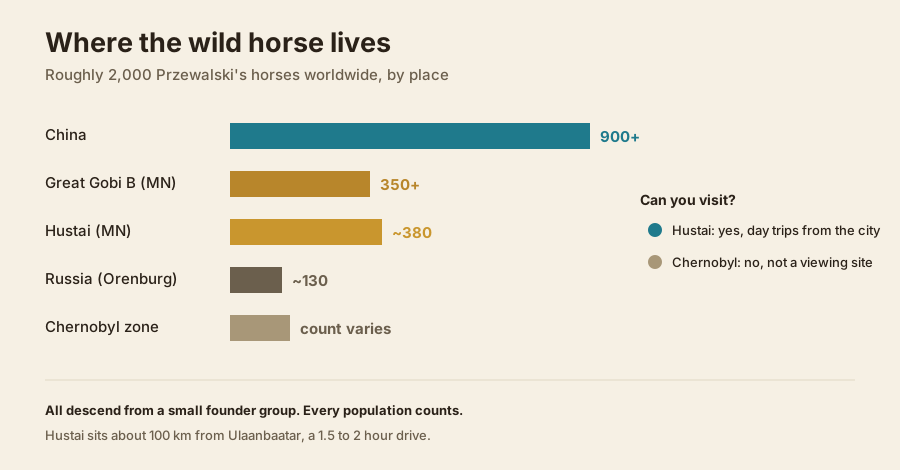
One honest note on the Chernobyl figure: reliable, current headcounts for the zone herd are hard to pin down and shift with each survey, so I will not put a single fixed number on it. What is solid is that the herd took hold after 1998 and persists. For the Mongolian numbers, which are counted every year, the record is far firmer.
| Population by place | Approximate figure | How firm is the count |
|---|---|---|
| Global total | Roughly 2,000 | Combined estimate across all sites |
| China | 900 or more | Reported 2026, largest single share |
| Hustai, Mongolia | ~380 (some reports ~450) | Counted yearly by the park |
| Great Gobi B, Mongolia | 350 or more | Conservation monitoring |
| Russia (Orenburg) | Around 125 to 133 | Regional reintroduction reports |
| Chernobyl zone | Free-roaming, count varies | Surveys inconsistent; no fixed figure here |
Where can you actually go to see the wild horse?
Hustai, without much competition. The Chernobyl zone is a restricted, hazardous area that is not a wildlife-viewing destination in any practical sense. Hustai is a working reserve about 100 kilometres from Ulaanbaatar, a 1.5 to 2 hour drive, set up for visitors, with rangers, viewing distances and day trips from the city. If seeing a takhi is the goal, Mongolia is the answer.
This is the part I most want people to hear clearly. Reading about horses in the exclusion zone is one thing; standing where you can watch them is another, and the two barely overlap. You do not go to Chernobyl to see wildlife. You come to Mongolia, drive out from the capital, and let a valley at dawn hand you a wild harem, which is the experience the whole best time to visit Hustai guide is built around.
The straightforward way to do it is a group day out that handles the drive, the entry and a local guide. I do not run that departure, so the listing is your source for exact inclusions and timings.
Common questions about Chernobyl and Hustai horses
Are the Chernobyl horses the same species as the takhi? Yes, both are Przewalski's horses, the wild takhi. The difference is how they got there and whether you can visit.
Can tourists see the Chernobyl horses? Not in any practical, reliable way. The exclusion zone is restricted and not managed for wildlife viewing.
Is Hustai safe and easy to reach? Yes. It is about a 1.5 to 2 hour drive from Ulaanbaatar on mostly paved road, with day trips available from the city.
Which population is bigger? China holds the most, at 900 or more. Hustai holds around 380, one of the largest free-ranging herds and the one set up for visitors.
The Chernobyl herd is a compelling accident, life reclaiming a place we broke. Hustai is the opposite: people deciding a wild horse belonged back on the steppe and doing the slow work to make it true. Both are worth knowing about. Only one of them is worth booking a drive out to see, and that one is here.
Choose Your Next Step
Private Hustai Wildlife Day
Have your travel date in mind? Check Private Hustai Wildlife Day before arranging the rest of your trip.
8 to 10 hours. Private transport, lunch and park admission; pickup offered from Ulaanbaatar. English, French, Korean or Russian. Wildlife and a dawn departure are not guaranteed. Not wheelchair accessible; not recommended during pregnancy.
Compare Trip Styles And Adjust Your Choice
- Six-Hour Hustai Day: About 6 hours. Downtown Ulaanbaatar hotel transfers, local lunch, entrance and an English- or Mongolian-speaking guide. Not suitable for mobility impairments. Sightings are not guaranteed. Arrange your own travel insurance.
- Two-Day Hustai And Nomadic Homestay: Two days with a private ger at a nomadic family, meals and Ulaanbaatar hotel pickup. English guiding. This is not either named Hustai tourist camp. Riding and the cultural show cost extra. Not wheelchair accessible.
This is trip guidance, not an eligibility or availability confirmation. Check the operator's restrictions for everyone travelling.
Choose a date to inspect the Viator departure schedule. Final availability and price are confirmed on Viator.